
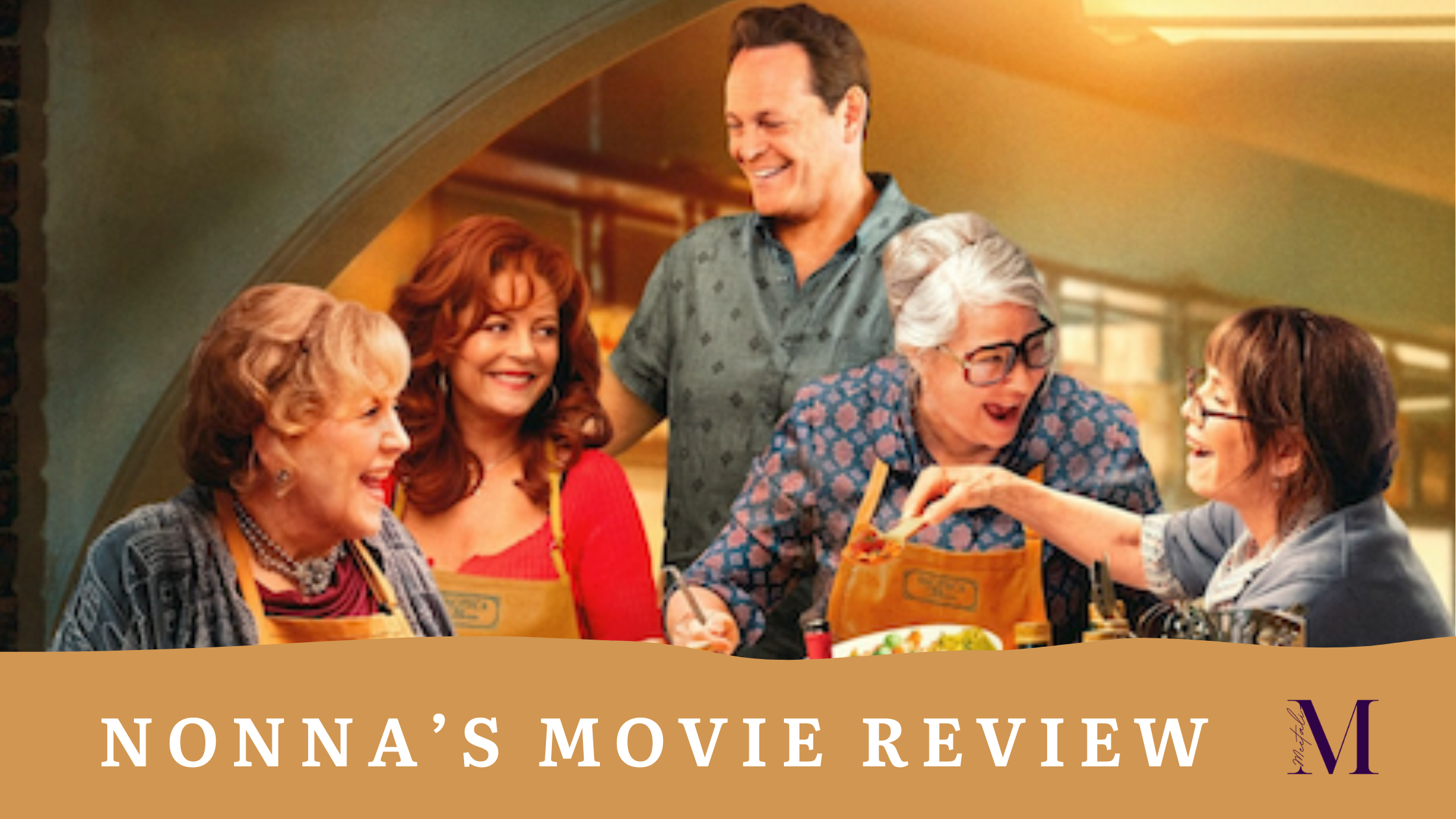
A Film That’ll Make You Laugh, Cry, and Crave Pasta
Nonnas: A Movie About Food, Family, and the Absolutely Necessary Use of Olive Oil
Let me just say it straight: I loved this movie like I love perfectly salted pasta water. Deeply. With intention.
This is your official Nonnas movie review, and I’m telling you: Nonnas is the kind of Italian food film 2025 was waiting for. You sit down expecting something light and vaguely charming about an American Italian man rediscovering his roots, and two hours later, you’re weeping into your tea towel, wondering if you should text your mother, your therapist, or your childhood neighbour who made ravioli from scratch in 1998.
It is that kind of film. And yes, it’s about food. But it’s also about grief, joy, and the radical act of making dinner for someone you love.
Vince Vaughn, but Make It Tender
In Nonnas, Vince Vaughn plays Joe, a Staten Island maintenance guy who’s lost his mother, his joy, and maybe a bit of himself. He’s not a burned-out chef or a food critic- he’s just a guy. A guy dealing with grief, loneliness, and a stubborn New York accent.
And then, he opens a restaurant. Not just any restaurant. One where real Italian nonnas cook the food of their youth, in their own way, with their own recipes. It’s chaotic. It’s imperfect. And it’s pure magic.
And for those of you asking what is a nonna or what does a nonna mean? It’s the Italian word for grandmother but it’s also a vibe. A nonna is someone who will insult your life choices while ladling you a third helping of ragù. She’s part therapist, part chef, part neighbourhood surveillance camera. In short: an institution.
I haven’t seen Vaughn this good in years. He’s wry, raw, and just awkward enough in an apron. You believe him. You root for him. You want him to win, because the idea he has is so beautiful that you don’t know why no one thought of it before.
The Real Stars: Nonna’s Cast of Legends
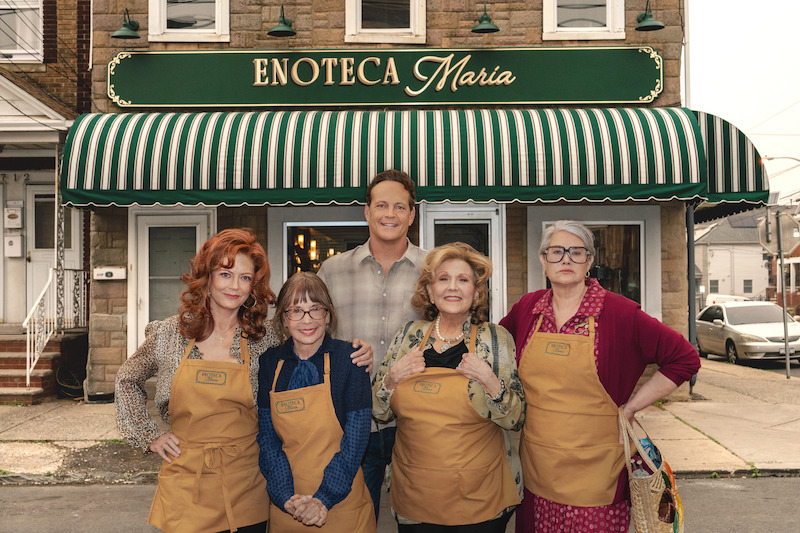
Credit: Jeong Park/Netflix
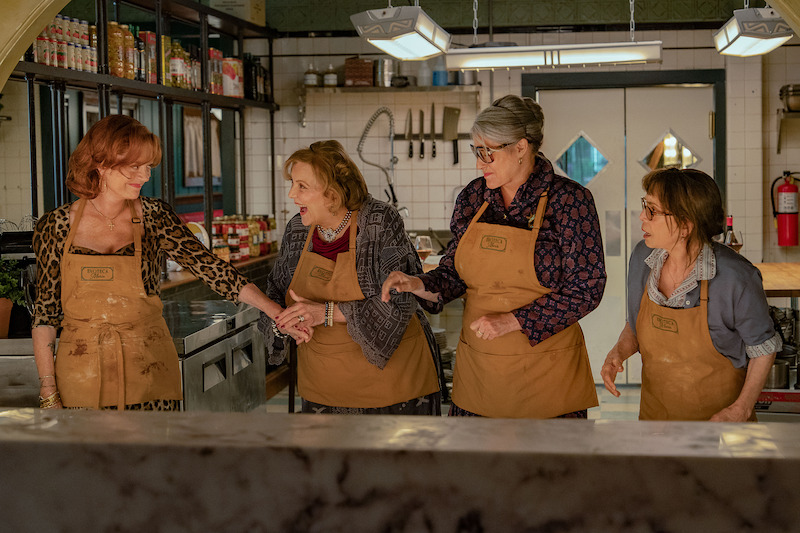
Now let’s talk about the Nonna’s cast, because this ensemble delivers standout performances across the board. The film doesn’t just revolve around food; it simmers with emotion, humour, and chemistry.
Orbiting Vaughn’s Joe is a constellation of powerhouse women and familiar faces who absolutely devour every scene they’re in:
Susan Sarandon brings a glamorous flair as Gia, Joe’s mother’s lifelong friend and hairdresser, who becomes the restaurant’s pastry chef, offering both desserts and wisdom. Lorraine Bracco is bold and outspoken as Roberta, a proud Sicilian and the first nonna to join Enoteca Maria, bringing her generations-old recipes and strong opinions. Her rapport with Brenda Vaccaro who plays Antonella, a feisty widow from Bologna who brings her passion for cooking and life to the restaurant, is a highlight to watch. Rounding them out is Talia Shire who portrays Teresa, a former nun with a quiet demeanor and a storied romantic history, adding depth and nuance to the kitchen dynamics.
Their performances are a masterclass in character. They steal the show with their sly humour, kitchen clatter, and side-eyes that could curdle milk. They don’t just represent heritage; they are the heritage. When they talk about food, you feel it in your molars. Food and memory served family-style. Nonna’s recipes are less about technique and more about instinct. One pinch of salt, two of heartbreak, and a whole lot of garlic.
Think of it like Call Me By Your Name, Chef, and a Hallmark Christmas film had a baby, and the godparents were Sophia Loren and Lidia Bastianich.
It must also be said, the Nonna’s nonna cast is so good, so effortlessly charming, that halfway through you find yourself wanting a spin-off where it’s just them bickering over sauce and laughing at Joe’s expense. Honestly, give them a bottle of limoncello and a dinner table, and I’d watch three seasons.
There’s something incredibly refreshing about seeing older women cast in roles that aren’t just token grandmothers, but full-bodied characters with backstories, sass, heartbreak, and bite. Nonna’s is quiet proof that women’s roles don’t need to fade after 35, they just need better writers, and ideally, more garlic.
Besides the Nonnas, the rest of the supporting cast is stellar. Joe Manganiello plays Bruno, Joe’s lifelong best friend and contractor. Bruno is the kind of guy who shows his love by swinging a hammer and delivering a perfectly timed meatball sub. Manganiello brings warmth and authenticity to the role, embracing his Italian heritage with pride. Drea de Matteo portrays Stella, Bruno’s wife and the neighbourhood’s resident truth-teller. As an interior designer, Stella helps Joe transform the restaurant space, all while offering candid advice and heartfelt support. Lastly, Linda Cardellini takes on the role of Olivia, Joe’s high school prom date turned legal advisor and love interest. Olivia, now a first-year law student, assists Joe with the restaurant’s legal matters and rekindles a connection that adds a layer of romantic tension to the story.
Visually Delicious
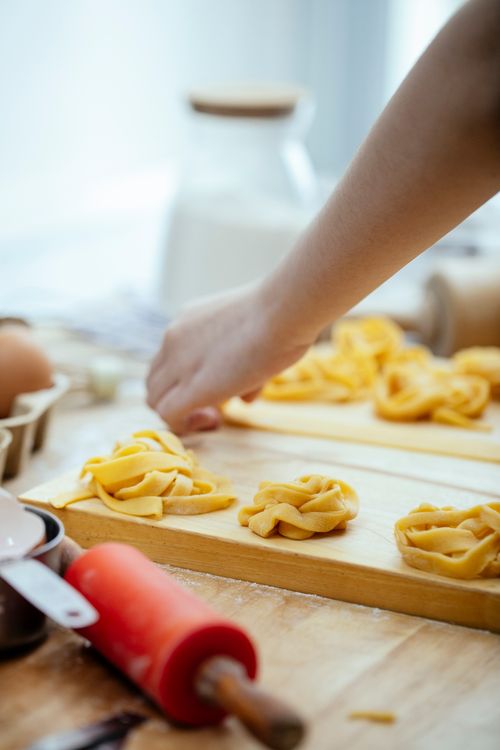
This is not your typical shiny, showy food movie. There are no tweezers or foams in sight. Nonnas is messy in the best way: sauce-splattered, flour-dusted, olive oil-slicked. The kind of food you want to bury your face in, not post about and forget.
The cinematography is rich and romantic. Sauces glisten. Garlic sizzles in slow motion. Recipes are handwritten in looping script that looks like a grandmother whispering across time.
And then there’s the lamb’s head.
Yes. A full-on, unapologetic lamb’s head makes an appearance – teeth, tongue, the works, courtesy of one of the more bold nonnas, who serves it with the casual confidence of someone who has absolutely seen things. It’s one of those unforgettable moments where the film reminds you: this is not some sanitised version of heritage cuisine. This is the real stuff. The parts people forget. The parts with stories.
When Joe eats a simple pasta dish made by one of the nonnas, you can practically see the grief and gratitude swirl together in the steam. That’s Nonnas in a bite. Food and memory inextricable.
This isn’t just one of the best food movies of the year. It’s one of the most truthful.
At one point, Jack finds an old handwritten sauce recipe from his mother, and you feel it in your chest. It’s not just a dish, it’s a resurrection. That moment alone qualifies this as one of the best food movies in recent memory.
Hospitality Is the Plot
As someone who lives and breathes restaurants, this film felt like a warm, perfectly set table. Nonnas captures the soul of Italian hospitality in cinema: the welcome, the tradition, the humour, the chaos.
It doesn’t try to be cool. It doesn’t fetishise food. It just loves it. In a way that reminds you why dinner tables matter, why recipes are memory maps, and why a bowl of pasta can say everything you never managed to.
A Bromance Built on Bricks, Not Feelings
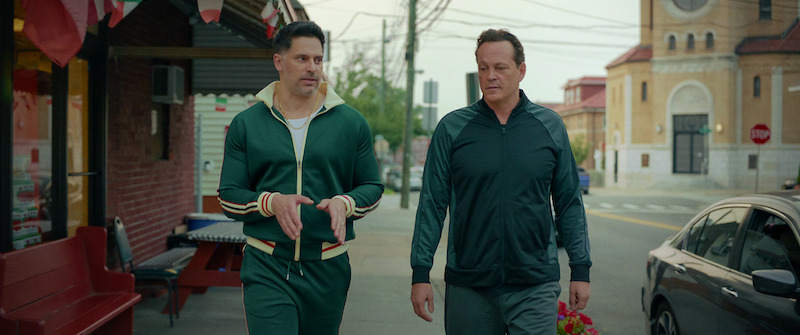
There’s a moment in Nonnas that slips in so softly, you almost don’t realise it’s an emotional sucker punch until later. Bruno, played by Joe Manganiello, is Joe’s childhood best friend. A contractor, a husband, a Staten Island guy’s guy. He’s the kind of man who speaks through action, not monologue. In other words, a classic male friendship.
There’s no dramatic outburst, no weepy heart-to-heart. But when Joe’s dream of opening the restaurant begins to wobble under the weight of permits and budget nightmares, Bruno quietly sells his car to keep things afloat. Not because he was asked to. Not because there was a grand gesture waiting to happen. Simply because his friend needed him, and that was enough.
It’s such a beautifully observed bit of emotional storytelling: this idea that men may not always talk about their feelings, but they’ll give you their car if it means seeing you happy. It lands especially well in a film that’s so much about community, chosen family, and the language of care.
Italian Nonnas, Indian Dadis: Cut From the Same Apron!
There’s also a strong thread of cultural overlap woven through Nonnas, one that feels instantly familiar if you’ve grown up in a desi household. These Italian grandmothers? They’re our dadi-mas, our naanis.
They hoard sugar sachets from cafés. They start cooking for 20 even when you only invited four. They believe in food as medicine, punishment, affection, apology, and celebration, often all in the same meal.
Whether it’s Nonna Roberta’s lamb’s head stew or your Amamma’s pepper rasam, both are rooted in instinct and served with the same line: “Beta, just taste it and tell me what it needs.” As if you’d dare critique it.
Like Italians, we give food in hard times. We bring rasam when someone’s sick, biryani when someone’s mourning, and something sweet the minute there’s even a whiff of celebration. We don’t ask, “How are you?” We say, “Have you eaten?”
In that way, Nonnas doesn’t feel foreign. It feels very close to home.
The True Story Behind Nonnas
The story that inspired Nonnas began long before the cameras rolled, in a quiet moment of grief and memory. After losing his grandmother, father, mother, and sister, Joe Scaravella, a Brooklyn-born MTA mechanic, found himself adrift. He moved to Staten Island, carrying his sorrow like luggage, and happened upon a vacant storefront near the St. George Theatre.
Instead of opening a traditional Italian restaurant, he chose to build something far more personal, a tribute to his family and the flavours of his childhood. In 2007, Joe opened Enoteca Maria, a place where the kitchen wouldn’t be run by trained chefs, but by grandmothers from different regions of Italy. These women brought their own handwritten recipes, their own dialects, and their own histories. One night might be Calabrian comfort food, the next Neapolitan or Sicilian, depending on who was cooking.
This wasn’t about precision plating or culinary theatre. It was about honouring the way food connects us to the people we’ve loved, and in many cases, lost. The smells, the textures, the rituals-all of it was meant to evoke home, memory, and continuity.
Years later, the idea expanded. Joe began inviting grandmothers from all over the world to cook at the restaurant, launching the “Nonnas of the World” initiative. Now, the rotating kitchen has hosted women from countries like Bangladesh, Poland, Syria, and Peru. One day it’s lasagna, the next it’s kabsa or pierogi.
In Nonnas, Vince Vaughn steps into Joe’s shoes, fictionalised but faithful in spirit, capturing that quiet ache of loss and the unexpected joy of rediscovery. While the characters in the film include composite elements and creative embellishments, the heart of the story remains rooted in truth: grief becoming a gathering, and strangers becoming family over saucepans and shared stories.
If you’re ever in Staten Island, you can still visit Enoteca Maria, sit at one of its tables, and eat a dish prepared by someone’s grandmother. It may not be your nonna, but it will feel close enough.
Final Thoughts
Nonnas is a film for anyone who’s ever tried to cook their way through grief, or joy, or uncertainty. It’s a reminder that sometimes, the biggest thing you can do is make a meal. And sometimes, achieving something amazing just means following your heart… all the way to a second helping.
So yes, this is a food movie. But it’s also a love letter.
Watch Nonnas with someone you love. Watch it hungry. Then make lasagna and call your mum.
Because if you ask me, that’s cinema.
*Cut to the Chase*
Pros: Vince Vaughn delivers a heartfelt performance; the ensemble cast, including Susan Sarandon, Lorraine Bracco, Talia Shire, and Brenda Vaccaro, shines; the film offers a rich portrayal of food and memory; visually stunning with mouth-watering dishes.
Cons: Some scenes may feel overly sentimental; the pacing is leisurely, which might not appeal to all viewers.
Stream or Skip: Stream it. Especially if you’re a fan of heartwarming stories that intertwine food, family, and rediscovery.
My Rating: 4.5/5
Where to watch Nonnas: Netflix
In the mood to taste some pasta that feels rustic and oh-so-good? Click here for a great suggestion. If you’d rather read more about food and culture, click here for my recommendation. Or if you want to watch something short and light after Nonnas click here.
More movie and TV reviews: my best and worst movies of 2021 and Ginny and Georgia Season 3.
This blog post is part of ‘Blogaberry Dazzle’
hosted by Cindy D’Silva and Noor Anand Chawla
in collaboration with Mister Tikku.

Leave a Reply